
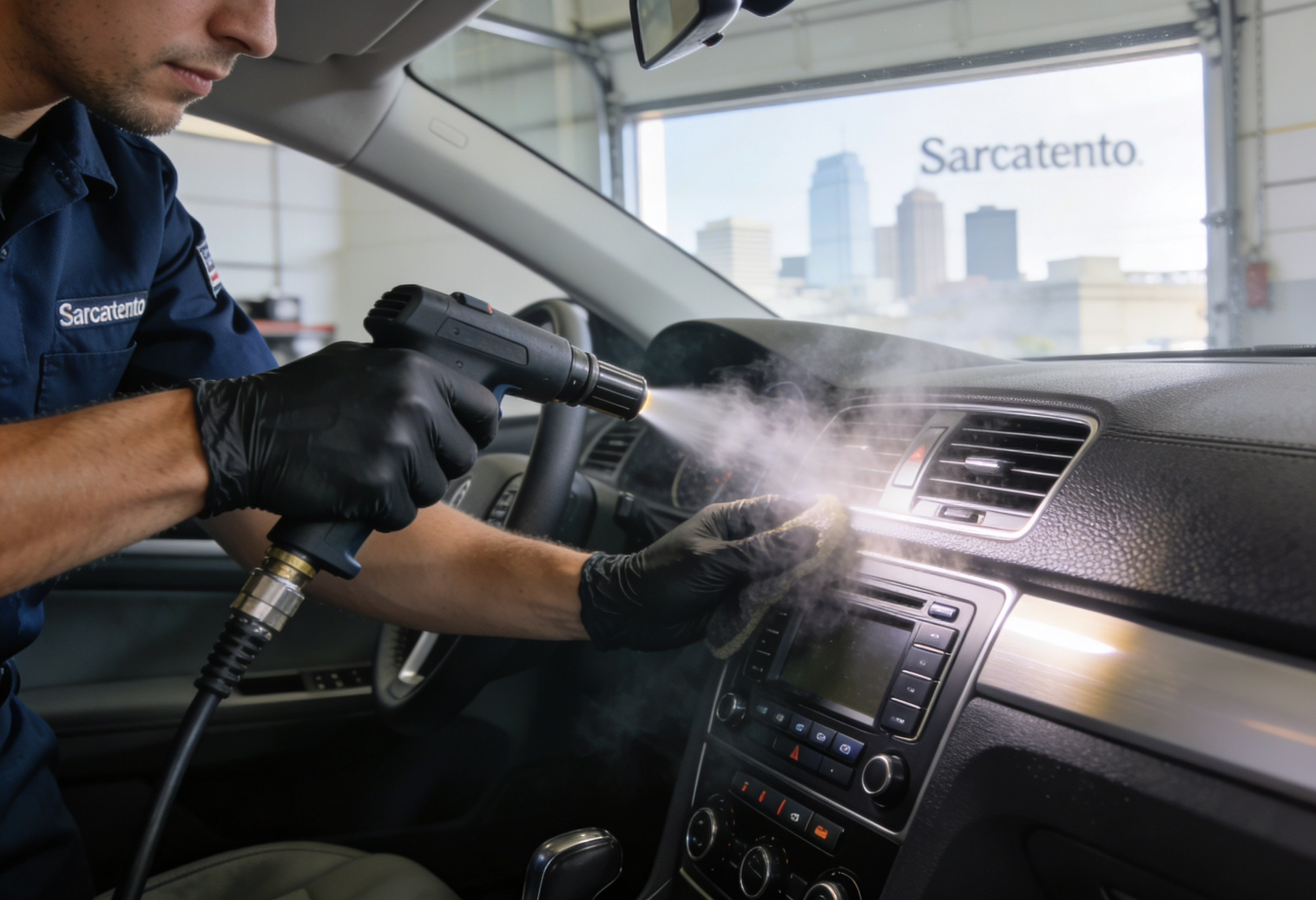
Steam cleaning sounds like the ultimate solution for a dirty car interior. High heat, no harsh chemicals, kills bacteria—what’s not to love?
Plenty, actually. While steam cleaning is a genuinely useful tool in professional detailing, it gets oversold constantly. The reality is more nuanced, and understanding what steam can and cannot do helps you choose the right service for your vehicle’s actual condition.
Here’s what Sacramento drivers need to know about steam cleaning a car interior, where it excels, where it falls short, and when extraction or other methods work better.
How Steam Cleaning Actually Works
Steam cleaners heat water to temperatures between 200°F and 300°F, producing vapor that loosens dirt, grease, and grime from surfaces [1]. The combination of heat and moisture breaks down contaminants without requiring heavy chemical cleaners.
For car interiors, steam cleaning offers several legitimate benefits:
- Surface sanitization — High temperatures can kill many bacteria and dust mites on contact [2]
- Grease and light soil removal — Steam cuts through oily residue on dashboards, door panels, and consoles
- Deodorizing effect — Heat helps neutralize some surface-level odors
- Chemical-free cleaning — Useful for sensitive occupants or eco-conscious customers
- Hard surface effectiveness — Works well on plastic, vinyl, glass, and metal trim
Steam also reaches into crevices that cloths and brushes cannot access easily—air vents, seams, textured plastics, and tight corners around buttons and controls.
The Heat-Chemistry-Dwell Triangle
Professional detailers understand something most steam-cleaning marketing glosses over: effective stain removal requires three elements working together.
Heat breaks molecular bonds and loosens contaminants. Steam delivers this well.
Chemistry targets specific stain types. Different stains respond to different cleaning agents—protein-based stains need enzyme cleaners, oil-based stains need degreasers, and tannin stains from coffee or tea require specialized solutions [3].
Dwell time allows cleaning agents to penetrate and break down embedded contaminants. Surface contact alone rarely removes deep stains.
Steam cleaning brings heat to the equation but lacks the other two components. For surface-level dirt and light contamination, heat and moisture alone often suffice. For anything embedded in fabric fibers or carpet padding, you need all three elements.
This is why a coffee spill that dried into your cloth seat two weeks ago will not steam out completely. The stain has bonded with fabric fibers at a level steam cannot reach without chemical assistance and adequate dwell time.
What Steam Cleaning Removes Effectively
Steam excels at specific cleaning tasks:
Hard Surfaces
Dashboards, center consoles, door panels, steering wheels, and plastic trim respond well to steam cleaning. The heat loosens accumulated dust, skin oils, food residue, and light grime without risking damage to most automotive plastics and vinyls.
Light Fabric Soiling
Fresh spills, surface dust, and light dirt on cloth seats and carpets can often be addressed with steam. The key word is “fresh”—stains that have not had time to set or penetrate deeply.
Leather Conditioning Prep
Steam can prepare leather surfaces for conditioning by opening pores and lifting surface contamination [4]. However, leather requires careful temperature control to avoid damage.
Glass and Chrome
Steam leaves glass streak-free and cuts through film buildup on chrome and metal trim effectively.
Odor Reduction
Surface-level odors from food, mild pet presence, or general staleness often improve after steam cleaning. The heat neutralizes some odor-causing bacteria living on surfaces.
What Steam Cleaning Cannot Do
Here’s where the overselling begins. Many steam cleaning services imply comprehensive sanitization and stain removal that the method simply cannot deliver.
Deep-Set Fabric Stains
Coffee, soda, pet accidents, food spills that have dried, and biological stains that penetrated carpet padding or seat foam will not steam out. The contamination exists below the surface, and steam affects primarily the top layer of fabric [5].
Embedded Pet Hair
Steam does nothing for pet hair. The moisture can actually make removal harder by causing hair to stick more firmly to fabric fibers.
Mold and Mildew in Padding
If moisture has penetrated into seat foam or carpet underlayment and created mold growth, steam addresses only the surface while the contamination continues below.
Old Biological Stains
Urine, vomit, blood, and similar organic stains require enzyme cleaners that break down proteins at a molecular level [6]. Steam does not deliver the chemistry these stains demand.
Set-In Odors
Odors that have penetrated into foam, padding, or headliner material will return after steam cleaning because the source remains untouched.
Heavy Soil Buildup
Years of accumulated dirt ground into carpet fibers requires extraction to physically remove the contamination, not just loosen it.
Steam Cleaning vs. Hot Water Extraction
Understanding the difference between these methods clarifies when each applies.
| Factor | Steam Cleaning | Hot Water Extraction |
| Method | Vapor applied to surface | Hot water and cleaning solution injected into fabric, then vacuumed out |
| Penetration depth | Surface to shallow | Deep into fibers and padding |
| Stain removal | Light surface stains | Embedded and set stains |
| Soil removal | Loosens soil | Physically removes soil |
| Drying time | Minutes | Several hours |
| Best for | Hard surfaces, light refresh | Deep cleaning, heavy contamination |
Hot water extraction—often called “steam cleaning” in carpet cleaning contexts, which adds confusion—actually injects heated cleaning solution into fabric under pressure, then immediately extracts it along with dissolved contaminants [7]. This process reaches deep into carpet pile, seat cushion fabric, and headliners in ways surface steam cannot.
For Sacramento vehicles dealing with serious interior issues, extraction typically delivers what steam cleaning promises but cannot achieve alone.
Fabric and Leather Considerations
Different interior materials respond differently to heat and moisture.
Cloth Seats and Carpets
Most automotive fabrics tolerate steam well, but excessive moisture or prolonged heat application can cause issues. Aggressive steam cleaning on certain synthetic fabrics may affect texture or cause shrinkage in rare cases.
Leather and Leatherette
Leather requires caution. Excessive heat can dry out natural oils, causing cracking and premature aging [8]. Quality leather interiors benefit from professional assessment before any heat-based cleaning method. Leatherette and vinyl-coated materials generally tolerate steam better but still require controlled application.
Alcantara and Suede
These materials need specialized care. Steam can damage the nap and texture of suede-like surfaces if applied improperly.
Headliners
Headliner fabric is typically adhesive-bonded to foam backing. Excessive moisture from any source—steam included—can weaken this adhesive and cause sagging or separation [9].
Drying Time Reality Check
Steam cleaning proponents often emphasize “quick drying” as a benefit. This is accurate for hard surfaces and very light fabric treatment.
However, if enough steam is applied to fabric to achieve meaningful cleaning, moisture penetrates and requires drying time. Rushing this process—closing up the vehicle before interior materials have dried—creates conditions for mold and mildew growth, particularly in Sacramento’s warmer months.
Hot water extraction requires longer drying time, typically several hours with good airflow. Professional services factor this into their process, often using air movers or leaving windows cracked to accelerate drying.
When You Need Extraction Instead of Steam
Choose extraction over steam cleaning alone when your interior shows:
- Pet accidents — Urine, vomit, or feces that have soaked into fabric
- Old food or drink spills — Stains that have had time to set
- Heavy soiling — Visibly dirty carpets, mats, or seats
- Smoke odor — Cigarette or fire smoke penetration
- Water damage — Flooding or significant moisture intrusion
- Biological contamination — Blood, illness-related cleaning needs
- Years of accumulated dirt — Vehicles that have not been deep cleaned in a long time
In these situations, steam cleaning may improve appearance temporarily but leaves the core contamination in place.
The Professional Approach
Quality detailing operations use steam as one tool among several, not as a complete interior solution. A thorough interior detail might combine:
- Vacuuming to remove loose debris and hair
- Steam cleaning for hard surfaces and light fabric refresh
- Enzyme pre-treatment for biological stains
- Hot water extraction for carpets and cloth seats
- Appropriate leather cleaning and conditioning
- Drying time with proper airflow
This layered approach addresses both surface and embedded contamination while protecting different material types appropriately.
Choosing the Right Service Level
For Sacramento drivers evaluating interior cleaning options, match the service to your vehicle’s actual condition:
Light maintenance cleaning — Recent interior detail, minimal soiling, no stains. Steam cleaning as part of a standard detail works well.
Moderate cleaning needs — Some visible stains, accumulated dust and grime, light odors. Consider services that include extraction for carpets and cloth seats.
Heavy contamination — Pet accidents, smoke exposure, significant staining, strong odors, or years without proper cleaning. Full extraction with appropriate pre-treatment delivers results steam alone cannot.
Honest assessment prevents both overpaying for services you do not need and disappointment when lighter cleaning fails to address deeper problems.
Book the Right Interior Detail for Your Vehicle
Understanding what steam cleaning can and cannot accomplish helps you choose services that match your vehicle’s actual needs. For light maintenance, steam works well as part of a comprehensive detail. For embedded stains, pet contamination, or heavy soiling, extraction-based cleaning delivers results that surface treatment cannot.
The Detail Pros Sacramento offers interior detailing services ranging from standard packages to deep extraction cleaning and specialized add-ons. Our technicians assess your vehicle’s condition and recommend the appropriate approach—not the most expensive option, but the right one.
Ready to get your interior properly cleaned? Book your detail today or contact us to discuss your vehicle’s specific needs.
Frequently Asked Questions
Does steam cleaning sanitize car interiors completely?
Steam cleaning sanitizes surfaces it contacts directly by killing many bacteria and dust mites through high heat exposure. However, it does not sanitize areas below the surface—carpet padding, seat foam, or fabric interiors where contamination has penetrated. Complete sanitization of embedded biological material requires extraction methods combined with appropriate cleaning agents.
Can steam cleaning remove pet urine smell from car seats?
Steam cleaning may temporarily reduce pet urine odor but rarely eliminates it completely. Urine penetrates fabric fibers and padding where steam cannot reach effectively. Proper removal requires enzyme cleaners that break down uric acid crystals combined with hot water extraction to physically remove contamination from deep within the material.
How long does a car interior take to dry after steam cleaning?
Hard surfaces dry within minutes after steam cleaning. Fabric surfaces may take one to several hours depending on how much moisture was applied and ambient conditions. Extraction cleaning requires longer drying time, typically four to eight hours with good ventilation. Closing up a vehicle before thorough drying risks mold and mildew growth.
Is steam cleaning safe for leather car seats?
Steam cleaning leather requires careful temperature control and technique. Excessive heat can dry out leather’s natural oils, potentially causing cracking and premature wear. Professional detailers typically use controlled steam application on leather, followed by conditioning to restore moisture balance. Some leather types tolerate steam better than others.
What’s the difference between steam cleaning and extraction for car interiors?
Steam cleaning applies heated vapor to surfaces, loosening dirt and killing surface bacteria. Hot water extraction injects cleaning solution deep into fabric, then vacuums it out along with dissolved contaminants. Steam works best for hard surfaces and light soiling; extraction removes embedded stains, heavy soil, and contamination that has penetrated into carpet padding or seat cushions.
About The Detail Pros Sacramento
The Detail Pros Sacramento brings professional detailing expertise to Sacramento-area vehicle owners through a network of vetted, certified technicians. With experience across interior and exterior detailing, paint correction, ceramic coating, and specialty services, our team helps customers choose the right service level for their vehicle’s actual condition—whether that means a standard detail package or targeted extraction cleaning for stubborn interior problems. We offer both mobile service and in-shop options to fit your schedule and location preferences.
Cited Works
[1] International Detailing Association — “Steam Cleaning Best Practices.” https://www.the-ida.com/
[2] Environmental Protection Agency — “Healthy Indoor Environments in Schools: Plans, Practices and Principles for Maintaining Indoor Air Quality.” https://www.epa.gov/
[3] Institute of Inspection, Cleaning and Restoration Certification — “IICRC S300 Standard for Professional Upholstery Cleaning.” https://iicrc.org/
[4] Leather Honey — “How to Clean Leather Car Seats.” https://www.leatherhoney.com/
[5] Carpet and Rug Institute — “Carpet Cleaning FAQ.” https://carpet-rug.org/
[6] American Cleaning Institute — “Enzyme-Based Cleaners.” https://www.cleaninginstitute.org/
[7] Institute of Inspection, Cleaning and Restoration Certification — “Hot Water Extraction Method.” https://iicrc.org/
[8] Leather Research Laboratory, University of Northampton — “Care and Maintenance of Leather.” https://www.northampton.ac.uk/
[9] 3M Automotive Aftermarket Division — “Headliner Repair and Maintenance.” https://www.3m.com/

 and then