
Your car’s paint tells a story—usually one about swirl marks from automatic washes, water spots from Sacramento’s hard water, and fine scratches from everyday driving. Most of these defects can be fixed. And knowing what you’re actually dealing with helps you choose the right fix without paying for work you don’t need.
Paint correction is one of the most misunderstood services in auto detailing. Some shops throw the term around like it’s a magic eraser for any paint problem. Others skip the explanation entirely and jump straight to pricing. Neither approach helps you make a smart decision about your vehicle.
Sacramento drivers should know this upfront: not every paint defect requires the same solution, and some defects can’t be corrected at all. Understanding the difference between a one-step polish and multi-step correction—and recognizing when your paint needs something else entirely—saves you money and protects your vehicle’s finish.
What Paint Correction Actually Does (and What It Can’t Fix)
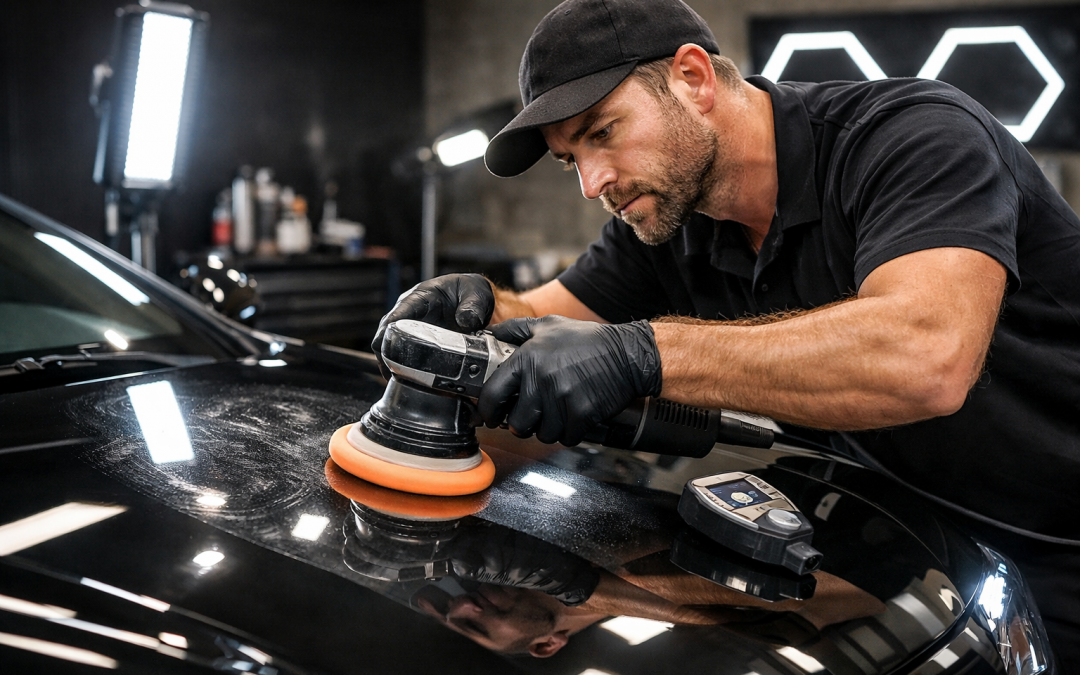
Paint correction is a mechanical process that removes a thin layer of clear coat to eliminate surface defects like swirls, scratches, oxidation, and water spot etching [1]. A skilled detailer uses machine polishers with specialized compounds and pads to level the paint surface, making defects disappear by removing the damaged clear coat around them.
Think of it like sanding a scratch out of wood. You’re not filling the scratch—you’re bringing the surrounding surface down to meet it.
This works well for defects that exist only in the clear coat layer. But if a scratch penetrates through the clear coat into the base coat or primer, no amount of polishing will fix it. You’d need touch-up paint or professional body work.
Defects That Respond Well to Correction
- Swirl marks: Those circular scratches visible in direct sunlight, usually caused by improper washing or automatic car washes [2]
- Light scratches: Surface-level marks that you can’t feel with your fingernail
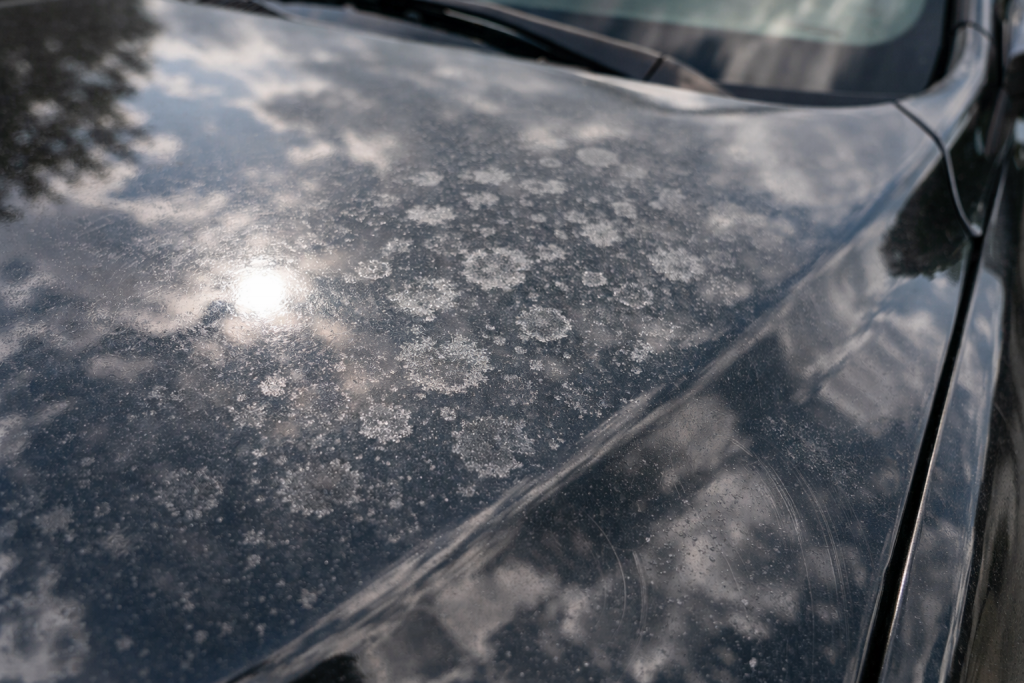
- Water spots: Mineral deposits from Sacramento’s notoriously hard water that etch into the clear coat surface
- Oxidation: Dull, chalky appearance caused by UV damage over time
- Buffer trails: Haze or holograms left behind from previous poor-quality polishing work
Defects That Need Something Other Than Correction
- Deep scratches: If your fingernail catches in it, correction alone won’t remove it
- Paint chips: Missing paint requires touch-up, not polishing
- Clear coat failure: Peeling, flaking, or severe oxidation often means the panel needs repainting
- Rust spots: Corrosion underneath requires repair, not surface polishing
A quick fingernail test gives you a rough idea: run your nail across the scratch. If it catches, you’re likely dealing with damage that goes beyond what correction can address.
Clear Coat Thickness: Why It Matters More Than You Think
Every modern vehicle has a clear coat layer protecting the colored base coat underneath. This clear coat is remarkably thin—typically between 1.5 and 4 mils (thousandths of an inch) from the factory, though it varies significantly between manufacturers [3]. Some economy vehicles leave the factory with thinner clear coat than luxury brands.
This matters for paint correction because every time paint gets polished, a small amount of clear coat gets removed. A single-stage polish might remove a fraction of a micron. More aggressive multi-step correction removes more [4].
That sounds tiny, and it is. But clear coat doesn’t regenerate. Once it’s gone, it’s gone. And once clear coat gets too thin, it loses its protective properties and becomes prone to failure.
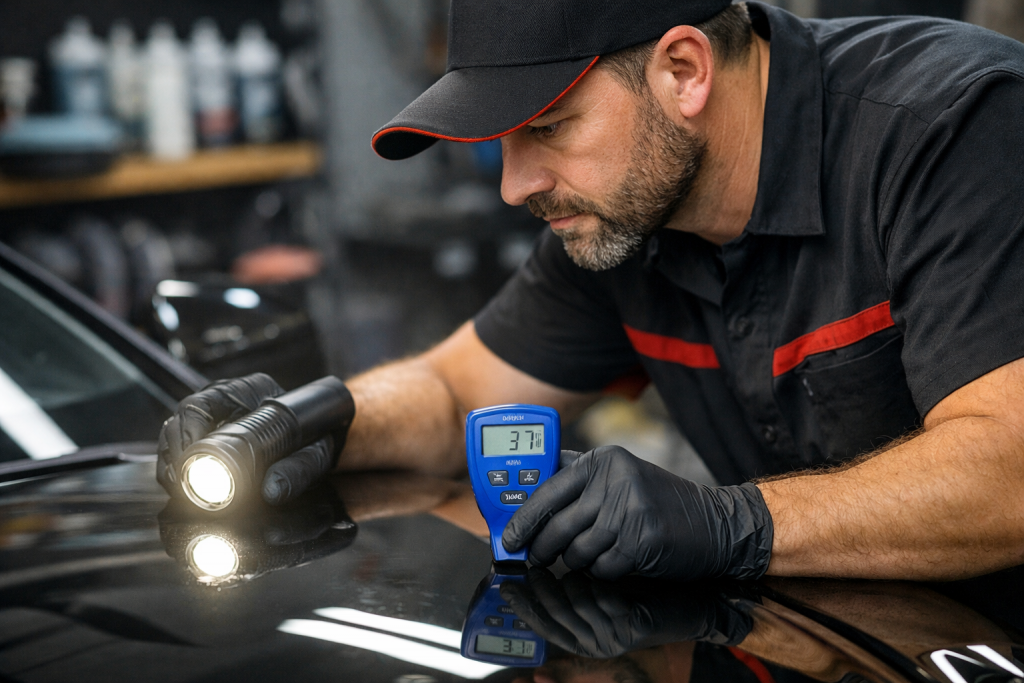
Professional detailers use paint thickness gauges before starting correction work. This measurement tells them exactly how much clear coat exists on each panel—and how aggressive they can safely be.
Panels that have been previously corrected, repainted, or simply came thin from the factory require a more conservative approach. A good detailer knows when to stop.
One-Step vs Multi-Step: Choosing the Right Level of Correction
Not all paint correction is created equal. The industry generally breaks the process into three main categories based on severity and the number of polishing stages involved.
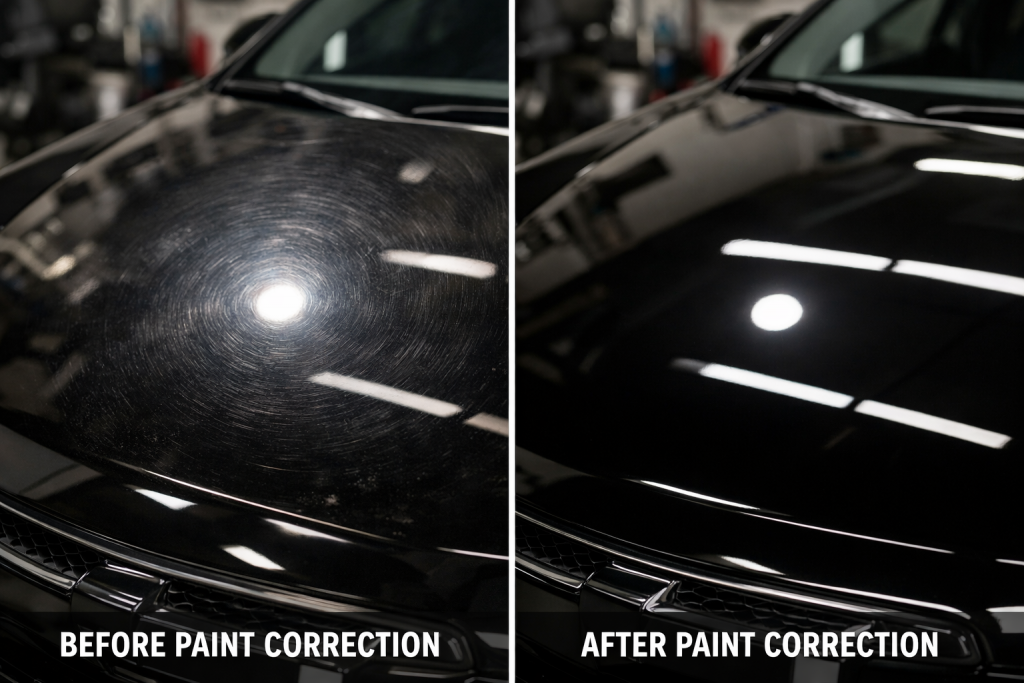
Quick Comparison: Correction Levels at a Glance
| Correction Level | Typical Defect Removal | Time Required | Best For | Relative Cost |
| One-Step Polish | 50–70% | 2–4 hours | Light swirls, minor haze, maintenance | $ |
| Two-Step Correction | 80–90% | 4–8 hours | Moderate swirls, visible scratches, pre-coating prep | $$ |
| Multi-Step (3+) | 90–95%+ | 8+ hours | Heavy oxidation, severe neglect, show prep | $$$ |
Note: Exact pricing varies based on vehicle size, paint condition, and clear coat thickness. Contact us for a specific quote.
One-Step Polish (Enhancement Polish)
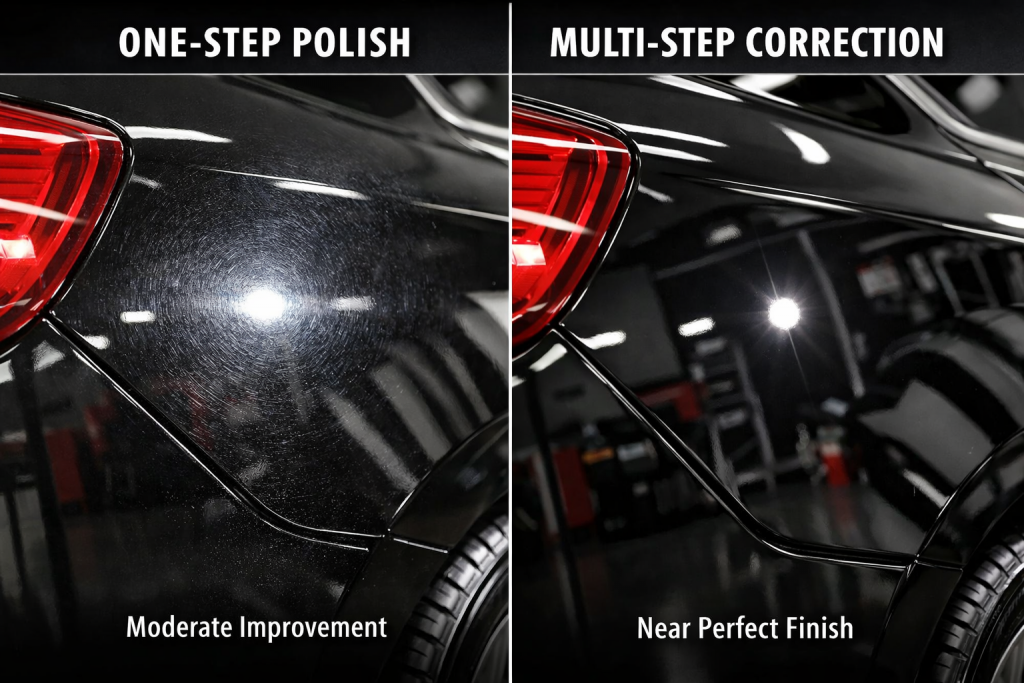
A one-step polish uses a single combination of compound, pad, and polishing technique to improve paint appearance in one pass. It’s designed to remove light defects while leaving a refined finish.
Best for:
- Light swirl marks
- Minor water spot etching
- General paint haze or dullness
- Vehicles with thinner clear coat that can’t handle aggressive correction
- Routine maintenance for previously corrected paint
What to expect:A one-step polish typically achieves 50–70% defect removal [5]. That might sound incomplete, but for many vehicles, eliminating the most visible swirls and restoring gloss makes a dramatic visual improvement. The remaining defects often become invisible except under harsh inspection lighting.
Time and cost:One-step correction usually takes 2–4 hours depending on vehicle size, making it more affordable than multi-step work.
Two-Step Correction
Two-step correction uses separate compounding and polishing stages. The first pass with a more aggressive compound removes heavier defects. The second pass with a finer polish refines the finish and removes any haze left by the compounding stage.
Best for:
- Moderate swirl marks visible in normal lighting
- Noticeable scratches that pass the fingernail test (you can see them but can’t feel them)
- Water spot etching with some depth
- Vehicles with adequate clear coat thickness
- Pre-coating preparation when you want maximum clarity
What to expect:Two-step correction typically achieves 80–90% defect removal, producing a noticeably deeper, cleaner finish than single-step work [5].
Multi-Step Correction (Three or More Stages)
For severely neglected paint, multiple cutting and polishing stages may be necessary. This approach uses progressively finer abrasives to remove heavy defects while achieving a high-gloss, refined finish.
Best for:
- Heavy oxidation
- Severe swirl damage from years of improper care
- Deep water spot etching
- Show car preparation
- Vehicles with thick, healthy clear coat
What to expect:Multi-step correction aims for 90–95%+ defect removal. Even the most aggressive correction has limits—the goal is achieving the best possible finish while preserving enough clear coat for long-term protection.
Sacramento-Specific Paint Challenges
Sacramento’s climate creates a particular combination of paint hazards that local drivers deal with year-round.
Hard Water and Mineral Deposits
The Sacramento region has some of California’s hardest water, with high concentrations of calcium and magnesium [6]. When water evaporates on your paint—whether from sprinklers, a recent wash, or morning dew—those minerals get left behind. Over time, they etch into the clear coat, creating spots that won’t wash off because they’re no longer sitting on the surface.
Light water spot etching often responds well to one-step correction. Deeper etching may require two-step work—or if left too long, can cause permanent damage that correction can’t fully address.
Sun Exposure and UV Damage
Sacramento averages over 260 sunny days per year [7]. All that UV exposure accelerates clear coat degradation, particularly on horizontal surfaces like hoods, roofs, and trunk lids that receive the most direct sun.
UV damage shows up as oxidation—that chalky, faded appearance. Moderate oxidation can be corrected. Severe oxidation where the clear coat has failed requires repainting.
Valley Dust and Contamination
Central Valley agriculture means Sacramento air carries more particulate matter than coastal cities. This contamination bonds to paint surfaces, creating a rough texture that washing alone doesn’t remove. Before any correction work, proper decontamination with clay bar treatment is essential to avoid grinding those particles into the paint during polishing.
How to Know What Your Vehicle Actually Needs
You often can’t tell from photos or even from looking at your car in the garage. Paint defects reveal themselves under direct light—specifically, the kind of focused lighting that detailers use for inspection.
A simple self-assessment you can do:
- Wash your car properly to remove surface contamination
- Examine the paint in direct sunlight or under a bright LED light held at an angle
- Look for swirl patterns, which appear as spider-web-like scratches radiating from a central point
- Run the fingernail test on visible scratches
- Check for dull or hazy areas, particularly on horizontal panels
If swirls are only visible under harsh lighting and disappear in normal conditions, one-step correction likely addresses your needs. If swirls are obvious in daylight and scratches are visible from arm’s length, two-step correction probably makes sense. If the paint looks severely neglected with heavy oxidation or marring, you may need multi-step work—or an honest conversation about what correction can realistically achieve.
Paint Correction and Ceramic Coating: Why They Work Together
Paint correction without protection is temporary satisfaction. You invest in removing swirls and scratches, then six months of improper washing or environmental exposure puts them right back.
Ceramic coating creates a hardened, hydrophobic layer over your corrected paint [8]. This protective barrier:
- Provides a sacrificial layer that takes wear instead of your clear coat
- Makes contamination easier to remove
- Offers UV protection to slow oxidation
- Repels water, reducing water spot formation
- Maintains the corrected finish significantly longer
Think of correction as the foundation and coating as the protection that preserves it. Applying ceramic coating to uncorrected paint locks in the defects. And correcting paint without protection leaves it vulnerable to rapid re-damage.
For Sacramento drivers dealing with hard water, intense sun, and valley dust, pairing paint correction with ceramic coating creates a maintenance-friendly surface that stays cleaner between washes and resists the environmental hazards that caused the original damage.
Important note: Ceramic coatings provide a sacrificial protective layer—they don’t make your paint scratch-proof. Proper washing technique still matters.
Questions to Ask Before Booking Paint Correction
Not all correction services are equal, and not all providers are transparent about what you’re getting. Before committing to paint correction, ask:
- Will you measure paint thickness before starting? A reputable detailer checks clear coat depth on every panel.
- What percentage of defect removal should I expect? Honest providers give realistic expectations, not promises of perfection.
- How many stages are included? Make sure you understand whether you’re getting a one-step polish or multi-step correction.
- What happens if defects can’t be corrected? Deep scratches or clear coat failure require different solutions.
- What protection do you recommend afterward? Correction without protection is a short-term fix.
- Can I see the results under inspection lighting? Before-and-after comparison under proper lighting shows exactly what was achieved.
When Paint Correction Isn’t the Answer
Sometimes the most valuable thing a detailer can tell you is that correction won’t solve your problem:
The paint has been previously corrected multiple times. If clear coat is already thin from prior work, aggressive correction risks burning through to the base coat.
Clear coat is failing. Peeling, flaking, or severely oxidized clear coat often means the panel needs repainting, not polishing.
Scratches are too deep. If damage penetrates beyond the clear coat, correction only makes it more visible by making the surrounding paint shinier.
The vehicle will be sold soon. For a car that’s leaving your hands shortly, the investment in correction may not make financial sense compared to a simple detail.
Budget constraints require compromise. A skilled one-step polish might be a smarter investment than a partial two-step correction if budget is limited.
Honest assessment up front saves everyone time and prevents disappointment.
Book an On-Site Paint Evaluation
The only way to know exactly what your vehicle needs is professional inspection under proper lighting with paint thickness measurement. Guessing based on photos or descriptions rarely leads to the right recommendation.
The Detail Pros Sacramento offers on-site paint evaluations where our certified technicians assess your vehicle’s actual condition—measuring clear coat thickness, identifying defect types, and giving you an honest recommendation about what level of correction makes sense for your situation.
Whether your paint needs a one-step enhancement, multi-step correction, or something beyond what polishing can fix, you’ll know exactly what you’re dealing with before committing to any service.
Ready to find out what your paint actually needs? Book an on-site paint evaluation and get a clear recommendation from our certified detailers—no guesswork, no surprises.
Frequently Asked Questions
How long does paint correction last?
Paint correction results are permanent in the sense that removed defects don’t come back on their own. However, new swirls and scratches can accumulate from washing, environmental exposure, and normal use. Without protection like ceramic coating, most vehicles show new swirl marks within 6–12 months of normal care. With proper coating and maintenance, corrected paint can stay defect-free for years.
Is paint correction safe for all vehicles?
Paint correction is generally safe when performed by trained professionals who measure clear coat thickness beforehand. Vehicles with factory-thin paint, previous correction work, or aftermarket repaints may have insufficient clear coat for aggressive correction. A paint thickness gauge reading before work begins determines how conservative the approach needs to be.
What’s the difference between polishing and paint correction?
Polishing is a general term for any process that enhances paint gloss and clarity. Paint correction specifically refers to the removal of defects like swirls, scratches, and oxidation through abrasive polishing. All paint correction involves polishing, but not all polishing constitutes correction—some products only add gloss without removing defects.
Can I do paint correction myself?
Basic paint enhancement is achievable for detail-oriented hobbyists with proper equipment and training. Machine polishing carries real risk of burning through clear coat, creating holograms, or causing uneven correction without experience. Professional correction typically delivers better results with less risk, especially for vehicles with unknown paint history or thin clear coat.
How often should paint be corrected?
Paint should be corrected only when defects warrant it—typically every 2–5 years depending on maintenance habits, environmental exposure, and whether protective coating is maintained. Over-correction thins clear coat unnecessarily. Proper washing technique and quality protection extend the time between correction needs significantly.
About The Detail Pros Sacramento
The Detail Pros Sacramento brings professional detailing experience to the greater Sacramento area. Our certified Master Detailers specialize in paint correction, ceramic coating installation, and comprehensive vehicle care for everything from daily drivers to classics and exotics. We measure paint thickness before every correction service, provide honest assessments about what your vehicle actually needs, and pair correction work with professional-grade protection to preserve your investment. Whether you need mobile service at your home or office or prefer our downtown Sacramento facility, we make professional paint care straightforward and convenient.
Works Cited
[1] International Detailing Association — “Paint Correction Defined.” https://www.the-ida.com/page/PaintCorrection
[2] Consumer Reports — “Are Automatic Car Washes Bad for Your Car?” https://www.consumerreports.org/cars/car-maintenance/are-automatic-car-washes-bad-for-your-car-a1086809498/
[3] ASTM International — “ASTM D7091: Standard Practice for Nondestructive Measurement of Dry Film Thickness.” https://www.astm.org/d7091-21.html
[4] Meguiar’s Professional — “Understanding Compounding and Polishing.” https://www.meguiars.com/professional/articles/understanding-compounding-and-polishing
[5] Rupes USA — “Paint Correction: Stages and Expected Results.” https://www.rupesusa.com/pages/paint-correction-guide
[6] Sacramento Suburban Water District — “Annual Water Quality Report.” https://www.sswd.org/departments/water-quality
[7] Western Regional Climate Center — “Sacramento Climate Summary.” https://wrcc.dri.edu/cgi-bin/cliMAIN.pl?ca7633
[8] Ceramic Pro — “How Ceramic Coatings Work.” https://www.ceramicpro.com/knowledge-base/how-ceramic-coatings-work/

 and then